
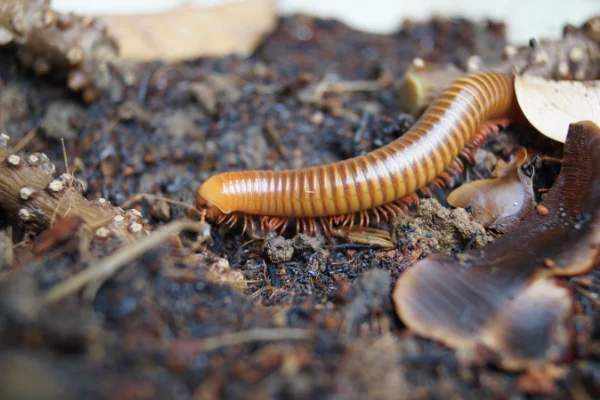
When heavy rain moves through Central Florida, you may suddenly notice millipedes crawling across sidewalks, patios, driveways, walls, or even inside your home. Millipedes need moisture to survive, and saturated soil can force them out of their normal hiding places as they seek drier areas. Large numbers may move toward homes and other structures, sometimes entering through small openings.
Sorko Lawn and Pest Control provides millipede control for homeowners dealing with recurring millipede activity. Understanding why millipedes appear, where they hide, and what may be attracting them to your property can help you determine when professional control may be needed.
What Are Millipedes?
Millipedes are wormlike arthropods with long, cylindrical bodies divided into many segments. Most body segments have two pairs of legs, and millipedes generally move slowly. Despite their nickname of “thousand-leggers,” they do not actually have a thousand legs.
Millipedes primarily feed on decaying organic material, including leaves, grass clippings, mulch, compost, and rotting vegetation. They typically live outdoors in damp, shaded areas where they can find moisture, food, and shelter.
Millipedes vs. Centipedes: What’s the Difference?
Millipedes and centipedes are often confused because both have many legs. However, several characteristics can help you tell them apart:
| Millipedes | Centipedes |
| Often range from about 1 to 4 inches long, depending on species | Usually range from about 1 to 6 inches long, depending on species |
| Commonly brown, black, gray, or reddish in color; some species have bands or other markings | Often yellowish, brown, reddish, or orange, sometimes with darker markings |
| Generally have a rounded or cylindrical body | Generally have a flatter body |
| Have two pairs of legs on most body segments | Have one pair of legs per body segment |
| Usually move slowly | Usually move quickly |
| Feed primarily on decaying plant material | Predators that feed on insects and other small animals |
| Often curl into a coil when disturbed | Usually move away quickly when disturbed |
| Do not bite or sting people | Some species can bite if handled or threatened |
Millipedes and centipedes differ significantly in their behavior and diets. Millipedes feed mainly on decaying organic matter, while centipedes hunt insects and other small prey. Millipedes are generally harmless to people and pets.
Common Millipedes in Central Florida
Florida is home to numerous millipede species. Some of the more recognizable types include the bumblebee millipede, rusty millipede, and Florida ivory millipede. The Florida ivory millipede is native to the state, while the bumblebee and rusty millipedes are introduced species.
Homeowners usually do not need to identify a millipede down to the species level to determine whether they have a problem. If large numbers are appearing around the home, the more important questions are where they are coming from and what conditions are allowing them to remain nearby.
Why Do Millipedes Appear After Heavy Rain?
Heavy rain can cause a noticeable increase in millipede activity. Millipedes normally live in moist soil and other damp environments, but when the ground becomes saturated, their underground habitat can become unsuitable. They may move toward higher or less-saturated areas, including nearby homes and other structures.
After significant rainfall, homeowners may find millipedes crossing sidewalks and driveways, climbing exterior walls, gathering around doors, or entering garages and homes. This can make it seem as though millipedes appeared suddenly, when they were actually living nearby all along.
Get a custom treatment plan tailored to you!
Click below to leave your information and we will call you right back!
Where Do Millipedes Live and How Do They Enter Homes?
Millipedes prefer damp, sheltered areas with plenty of moisture and decaying organic material. They are commonly found around landscaping and other protected areas, but heavy rain can cause them to move toward homes.
Once they reach the house, they may enter through small gaps and openings around the exterior. Common millipede hiding places and entry points include:
- Mulch and landscape beds.
- Leaf litter, grass clippings, and decaying vegetation.
- Under rocks, boards, logs, and other objects.
- Beneath flower pots.
- Damp or shaded soil.
- Gaps beneath exterior doors.
- Cracks or openings around the foundation.
- Gaps around windows.
- Openings where utility lines enter the home.
- Other small openings around the exterior.
Reducing moisture and organic debris and sealing entry points can help limit millipede activity. A residential pest control expert can identify conditions contributing to recurring problems.
Are Millipedes Dangerous?
Millipedes are generally not dangerous to people or pets. They do not bite or sting, and they do not damage the structure of a home, furniture, or food. Their primary concern for homeowners is that they can become a significant nuisance when large numbers appear.
Some millipedes can release a defensive secretion when disturbed. This may produce an unpleasant odor and can irritate or discolor skin, so it is best to avoid handling them directly.
Millipedes also generally do not establish themselves indoors like ants or cockroaches. They need moisture and typically do not survive for long in the dry conditions inside a home.
What Can You Do About Millipedes?
Homeowners can take several steps to make the property less favorable to millipedes. Removing accumulated leaf litter and decaying vegetation, managing mulch, reducing unnecessary moisture, and addressing drainage problems can help reduce conditions that attract them.
It can also help to inspect the exterior for obvious gaps beneath doors and around the foundation. Indoors, an occasional millipede can generally be removed with a broom, dustpan, or vacuum.
The University of Florida Institute of Food and Agricultural Sciences (UF/IFAS) notes that eliminating outdoor hiding places, food sources, and moisture can help reduce millipede populations, while outdoor treatments may sometimes be necessary when they become a serious nuisance.
Professional Millipede Control in Central Florida
Millipedes are a natural part of Florida’s environment, but large numbers can quickly become a nuisance. Heavy rain and saturated soil can drive them from their normal habitat, while mulch, leaf litter, decaying vegetation, and moisture around the property can provide favorable conditions nearby.
Professional control is needed when large numbers continue appearing around the home, especially after heavy rain, or when millipedes repeatedly enter the house despite efforts to address moisture and other outdoor conditions. Our team at Sorko Lawn and Pest Control provides professional millipede control throughout Central Florida when recurring activity becomes a problem.
Contact Sorko Lawn and Pest Control to learn more about our Millipede control options.
Back to Home Pest Control